Ethical and Legal Considerations

Deceptive mobile marketing practices are both illegal and unethical.  Every year there are numerous consumers injured by these poor marketing behaviors and some companies are sued by individuals or by class action lawsuit.  Also, the federal government, specifically the Federal Trade Commission (FTC) commonly sues companies over deceptive marketing practices, but also the Consumer Financial Protection Bureau (CFPB) can investigate, or even Department of Justice (DOJ) can also choose to prosecute in coordination with the FTC, particularly in broad consumer fraud matters.

Some recent illegal mobile marketing practices that have been settled by the FTC are:

Cerebral (an online mental health care service provider)– Over deceptive cancellation practices that have led to $ 5 million in refunds sent back to consumers.  FTC allegations are they required clients to navigate a complex process in cancelling their subscriptions and slow -walking their requests and billing them in the process, along with disclosing sensitive personal health information and other sensitive data to third parties for advertising.  According to the FTC, “Cerebral violated the Restore Online Shopper’s Confidence Act by failing to clearly disclose all material terms of their cancellation policies before charging customers”.  In implementing a multi-step and multi-day process to cancel membership this had negative consequences on consumer as they are being billed for unwanted services.  If personal health information is also transmitted to third party for advertising this can have negative consequences to customers since their private information is then made public and could potentially lead to unwanted deceptive acts such as scams, phishing, etc. (Delapuente, 2025)

Another recent FTC settlement regarding deceptive marketing methods was brough against Amazon in September 2025.  The FTC allegations against Amazon is” they used deceptive methods to sign up customers for Prime subscriptions and made it exceedingly difficult to cancel” per FTC.  FTC secured a $2.5 billion settlement stating that Amazon enrolled consumers into Prime subscriptions without their consent with also making it hard to cancel.  FTC charged Amazon for violating the FTC Act and the Restore Online Shoppers’ confidence Act (ROSCA) with a $ 1 billion civil penalty and $1.5 billion in refunds back to harmed consumers (FTC Secures Historic $2.5 Billion Setttlement Against Amazon, 2025). This causes negative consequences on the consumer as they are billed for unwanted services and could potentially cause monetary harm if they don’t have the money available to pay the charges

Google was recently sued by class action lawsuit due to its “Location History” feature that allegedly continued to collect location data despite consumers turning of their location history in their device.  An agreement was approved for $62 million and under the terms of the agreement most of the money would go to third party interest groups as cy pres awards, but this is being opposed by the 250 million mobile device users (class members) and their appeal is still pending.  The law that was broken with this deceptive act is the FTC Act, Section 5. Google was also sued by California for the same violation for its California Invasion of Privacy Act (CIPA) for $93 million and also in Europe for violating the GDPR by tracking sensitive location data.  Google stated the data was used for targeted advertising ads by profiling.  The total settlement for this location tracking was $392 million, levied by governments and states against Google (Allyn, 2022)

When companies violate legal considerations, their possible penalties can be fines, restitution, injunctions, criminal charges, reputational damage, regulatory sanctions, and additional penalties based on the severity and nature of each violation and can be multiplied for each infraction.  Financially companies can be charged with fines and / civil penalties and additional charges brought if they defy a “Notice of Penalty Offense” on deceptive advertising, privacy violations, or false marketing claims (FTC, 2021).  Restitution and compensation can be levied under legal considerations by requiring the company to refund unauthorized charges, thus compensating affected parties for their losses.  If a company receives court orders to cease certain violations of deceptive advertising, then they could have an injunction to trigger greater penalties or legal action to include criminal liability.  If it is known by  company executives or employees of intentional legal violations then criminal charges of imprisonment in addition to corporate fines.  Lastly, noncompliance with legal considerations could ultimately lead to regulatory or license restrictions such as suspension of license, permit revocation, or restrictions on business activities (Kroeck, n.d.).

Despite many legal ramifications that can interfere with a company’s business, the ultimate damage done when they violate legal considerations, is loss of sales, reputation, brand loyalty, investor confidence, and loss of contracts or partnerships (Rey, 2023).

Steps and actions that an ethical marketer must take with all mobile marketing campaign:

  • Follow all applicable laws and regulations with integrity to ensure actions align with words and values that demonstrate responsibility to all stakeholders, and avoid doing harm (AMA, 2025).
  • Avoid all deceptive practices by providing truthful and accurate information regarding all products and services, avoid misleading claims or false advertising.
  • A key action should be to compile an ethical marketing policy guide through written ethical standards and guidelines for marketing practices and including what claims can and cannot be made, data collection standards, and especially an internal consequence if violations are found (Flanagin, 2024)
  • Ensure that all marketing materials are reviewed and fact-checking pipeline before releasing.
  • Always obtain users consent to include communicating collection practices and how information will be used, and ensure users are aware and agree to all terms of service.
  • Always provide clearly accessible opt-out and unsubscribe options so users can mange their preferences of settings (Flanagin, 2024).
  • Handle all personal data responsibly with secure storage and comply with all relevant data protection regulations.

References

Abogado, R. (2023, December 29). Consequences of Noncompliance with Legislation by Companies: Explained Ordinance – Rey Abogado. King Lawyer. https://reyabogado.com/us/what-happens-if-a-company-doesnt-follow-legislation/

Allyn, B. (2022, November 14). Google pays nearly $392 million to settle sweeping location-tracking case. NPR. https://www.npr.org/2022/11/14/1136521305/google-settlement-location-tracking-data-privacy

AMA. (2025, July 15). Marketing Ethics. American Marketing Association. https://www.ama.org/marketing-ethics/

Delapuente, J. (2025, November 30). When Mobile Marketing Crosses the Line: Lessons From the FTC and What Brands Must Do Next. Jhonndelapuente. https://jhonndelapuente.wordpress.com/2025/11/30/when-mobile-marketing-crosses-the-line-lessons-from-the-ftc-and-what-brands-must-do-next/

Federal Trade Commission. (2021, September 9). Notices of Penalty Offenses. Federal Trade Commission. https://www.ftc.gov/enforcement/penalty-offenses

Flanagin, J. (2024, December 24). Ethical Marketing Guide: Best Practices for Ethical Marketers. Shopify. https://www.shopify.com/blog/ethical-marketing

FTC Secures Historic $2.5 Billion Settlement Against Amazon. (2025, September 25). Federal Trade Commission. https://www.ftc.gov/news-events/news/press-releases/2025/09/ftc-secures-historic-25-billion-settlement-against-amazon

Kroeck, L. (n.d.). What Are the Penalties If a Corporation Violates the Law? Legal Beagle. https://legalbeagle.com/what-are-the-penalties-if-a-corporation-violates-the-law.html

MORE THAN $5 MILLION IN REFUNDS SENT TO CONSUMERS AS A RESULT OF THE FTC’S ACTION AGAINST CEREBRAL OVER DECEPTIVE CANCELLATION PRACTICES. (2025, May 8). Nexis Uni; States News Service. https://advance-lexis-com.eu1.proxy.openathens.net/document/index?crid=87a2b79c-bdc5-489e-9575-38e030fe338f&pdpermalink=484ad029-77ce-48ad-87e7-5bfc20dc2d39&pdmfid=1519360&pdisurlapi=true

Marketing Advantage of Mobile Phones and Tablets

Blog:  Marketing Advantages of Mobile Phones and Tablets

The primary reason for accessing and using digital marketing channels on mobile phones and tablets are that they generally are within arm’s reach of customers at all times, thus allowing for timely and relevant messages.  There are over 6.7 billion mobile devices in use worldwide with an extended reach into most markets.  Mobile digital marketing allows for complete flexibility using omnichannel filters such as apps, social media, and websites.  Engaging with potential consumers at their preferred location and time allows for location-based market targeting to increase product sales and awareness.  Traditional marketing channels of TV, mail, or print ads is very expensive, time consuming, large environmental impact, difficult to measure effectiveness, and generalizes to a broad market with limited viewers (Racca, 2025).  A primary reason for its continued existence is that print ads continue to be a more trusted form of advertising, sometimes the material is kept for up to 17 days, and magazines can be collected to have longer shelf life.  Print ads are shown to have a longer view life by at least a double margin (Racca, 2025).

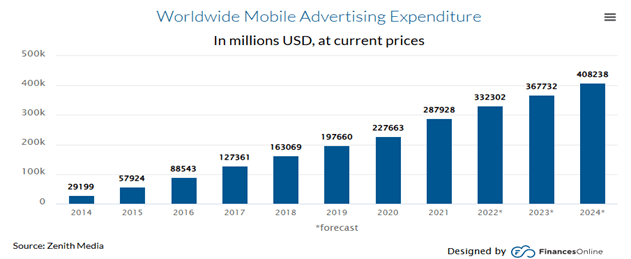
Use of mobile marketing enables personalized targeted campaigns to drive sales with easier reach to potential consumers.  Mobile marketing allows for increased brand awareness and increases point-of-sale conversions by using geo-fencing with reminder of product availability when they visit or are near a physical store.  Mobile devices are excellent tools to engage customers and ideal for them to use and manage loyalty programs that are offered or integrated into apps; thus, the consumer can easily track points and redeem rewards at their own leisure, fostering further brand loyalty.  Mobile channels can facilitate direct communication vis SMS marketing and allow promotional updates with push notifications as a direct communication line to consumers (Koehler, 2019).  Per Klaviyo, “Worldwide spending on mobile advertising achieved a 23% year-on-year growth in 2021.  Mobile ad spending is also expected to exceed $330 billion by the end of 2022” (Gilbert, 2022).

Mobile marketing campaigns can generate dialogue-marketing contacts and is replacing the term ‘direct marketing” in common speech.  Dialogue marketing is defined as “all marketing activities in which media is used with the intention of establishing an interactive relationship with individuals.  The aim is to initiate an individual, measurable response from the recipient”.

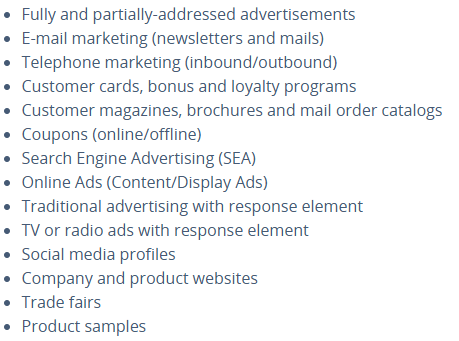
Rather than mass marketing techniques businesses must adapt to targeting groups of individual customers to encompass a specific niche.  Use of dialogue-oriented media reduces a campaigns high scattered losses, thus the need for internet-based communications in marketing, customer service, and even sales.  Use of interaction via multichannel mediums and make responding to their ads as simple as possible, such as:  helplines, pre-addressed envelopes, and even financial incentives such as discounts, early bird offers, discounts for referrals, and money-back if dissatisfied.  All of these elements can be measured and tracked for their success and return-on-investment (ROI).  Key-point-indicators (KPI) can easily be tracked with data analysis of metrics using many tracking tools such as Google Analytics, Piwik, and etracker.  In highly competitive markets, customer relationships create brand loyalty and decrease scattering loss though effective advertising and affective communications.  The cost-effectiveness of keeping customers with investment of dialogue marketing is much less expensive than recruiting new customers.  So, with the right message the perception reputation can be sustained and loyalty kept with personalized offers to regular customers, even if return feedback is not received (What is Dialogue Marketing, 2022).  Current dialogue marketing methods used are:

Customer loyalty is led by mobile marketing campaigns by tailoring content based on individual preferences and behaviors that resonate with users.  Successful use of mobile marketing can foster a deeper brand loyalty via interactive / immersive experiences.  Apps that require repeat interactions such as gamification can encourage community building among its users.  Seamless omnichannel experiences with mobile applications that integrate online and offline customer engagement, thus engaging customer touchpoints.  Brands that leverage this experience can connect deeply with their customers and lead to increased brand loyalty and advocacy (Hasson, 2025)

Some strategies to addressing the common constraints that mobile marketing faces are transparency regarding data collection and usage to build trust with a brand.  To reduce ad fatigue marketers should focus on providing value through personalized messaging to include frequency caps, deliver only requested relevant content, and most of all avoiding overexposure to ads.  Per Miller-Bernstein “Pop-up, banner, and other display ads have become so pervasive that many consumers are in the habit of ignoring them completely.  With a pop-up, for instance, you many only get your ad in front of a buyers’ eyes for as long as it takes them to find the button to close it.  Many Millennial and Gen Z generations use ad blockers and pop-up blockers when they browse’ (Racca, 2025).

References

Gilbert, N. (2022, April 15). Benefits and Advantages of Mobile Marketing: What You Need to Know. Financesonline.com. https://financesonline.com/benefits-and-advantages-of-mobile-marketing-what-you-need-to-know/

Hassan, S. (2025, January 6). The rise of mobile technology has transformed how brands connect with consumers. Mobile marketing, defined as promotional activities delivered through smartphones, tablets, and other mobile devices, has become a core strategy for modern businesses. Linkedin.com. https://www.linkedin.com/pulse/impact-mobile-marketing-consumer-engagement-shayaike-hassan-w00re/

Koehler, E. (2019, November 11). Marketing Advantages of Mobile Phones and Tablets. EK Marketing Blog by Ericka Koehler. https://ekoehler7.wordpress.com/2019/11/10/advantages-of-mobile-phones-and-tablets-as-a-marketing-tool-over-traditional-marketing-channels/

Racca, A. (2025, February 19). Are Print Ads Still Worth It? The Pros and Cons of Print Advertising in the Digital Age | Miller Bernstein. Miller Bernstein. https://millerbernstein.com/2025/02/19/are-print-ads-still-worth-it-the-pros-and-cons-of-print-advertising-in-the-digital-age/What is Dialogue Marketing? (2022, October 27). IONOS Digitalguide. https://www.ionos.com/digitalguide/online-marketing/online-sales/dialogue-marketing-interactive-relationships-with-customers