Blog: Marketing Advantages of Mobile Phones and Tablets
The primary reason for accessing and using digital marketing channels on mobile phones and tablets are that they generally are within arm’s reach of customers at all times, thus allowing for timely and relevant messages. There are over 6.7 billion mobile devices in use worldwide with an extended reach into most markets. Mobile digital marketing allows for complete flexibility using omnichannel filters such as apps, social media, and websites. Engaging with potential consumers at their preferred location and time allows for location-based market targeting to increase product sales and awareness. Traditional marketing channels of TV, mail, or print ads is very expensive, time consuming, large environmental impact, difficult to measure effectiveness, and generalizes to a broad market with limited viewers (Racca, 2025). A primary reason for its continued existence is that print ads continue to be a more trusted form of advertising, sometimes the material is kept for up to 17 days, and magazines can be collected to have longer shelf life. Print ads are shown to have a longer view life by at least a double margin (Racca, 2025).
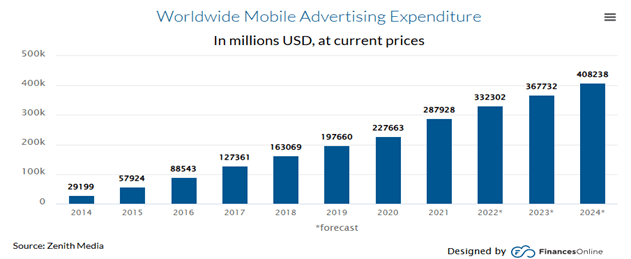
Use of mobile marketing enables personalized targeted campaigns to drive sales with easier reach to potential consumers. Mobile marketing allows for increased brand awareness and increases point-of-sale conversions by using geo-fencing with reminder of product availability when they visit or are near a physical store. Mobile devices are excellent tools to engage customers and ideal for them to use and manage loyalty programs that are offered or integrated into apps; thus, the consumer can easily track points and redeem rewards at their own leisure, fostering further brand loyalty. Mobile channels can facilitate direct communication vis SMS marketing and allow promotional updates with push notifications as a direct communication line to consumers (Koehler, 2019). Per Klaviyo, “Worldwide spending on mobile advertising achieved a 23% year-on-year growth in 2021. Mobile ad spending is also expected to exceed $330 billion by the end of 2022” (Gilbert, 2022).
Mobile marketing campaigns can generate dialogue-marketing contacts and is replacing the term ‘direct marketing” in common speech. Dialogue marketing is defined as “all marketing activities in which media is used with the intention of establishing an interactive relationship with individuals. The aim is to initiate an individual, measurable response from the recipient”.
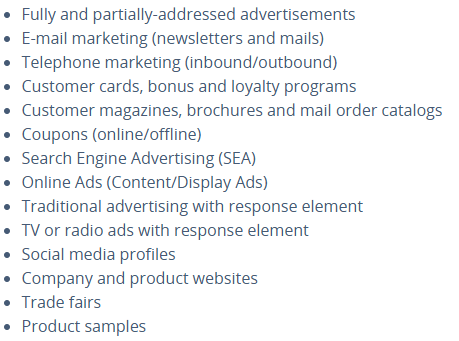
Rather than mass marketing techniques businesses must adapt to targeting groups of individual customers to encompass a specific niche. Use of dialogue-oriented media reduces a campaigns high scattered losses, thus the need for internet-based communications in marketing, customer service, and even sales. Use of interaction via multichannel mediums and make responding to their ads as simple as possible, such as: helplines, pre-addressed envelopes, and even financial incentives such as discounts, early bird offers, discounts for referrals, and money-back if dissatisfied. All of these elements can be measured and tracked for their success and return-on-investment (ROI). Key-point-indicators (KPI) can easily be tracked with data analysis of metrics using many tracking tools such as Google Analytics, Piwik, and etracker. In highly competitive markets, customer relationships create brand loyalty and decrease scattering loss though effective advertising and affective communications. The cost-effectiveness of keeping customers with investment of dialogue marketing is much less expensive than recruiting new customers. So, with the right message the perception reputation can be sustained and loyalty kept with personalized offers to regular customers, even if return feedback is not received (What is Dialogue Marketing, 2022). Current dialogue marketing methods used are:
Customer loyalty is led by mobile marketing campaigns by tailoring content based on individual preferences and behaviors that resonate with users. Successful use of mobile marketing can foster a deeper brand loyalty via interactive / immersive experiences. Apps that require repeat interactions such as gamification can encourage community building among its users. Seamless omnichannel experiences with mobile applications that integrate online and offline customer engagement, thus engaging customer touchpoints. Brands that leverage this experience can connect deeply with their customers and lead to increased brand loyalty and advocacy (Hasson, 2025)
Some strategies to addressing the common constraints that mobile marketing faces are transparency regarding data collection and usage to build trust with a brand. To reduce ad fatigue marketers should focus on providing value through personalized messaging to include frequency caps, deliver only requested relevant content, and most of all avoiding overexposure to ads. Per Miller-Bernstein “Pop-up, banner, and other display ads have become so pervasive that many consumers are in the habit of ignoring them completely. With a pop-up, for instance, you many only get your ad in front of a buyers’ eyes for as long as it takes them to find the button to close it. Many Millennial and Gen Z generations use ad blockers and pop-up blockers when they browse’ (Racca, 2025).
References
Gilbert, N. (2022, April 15). Benefits and Advantages of Mobile Marketing: What You Need to Know. Financesonline.com. https://financesonline.com/benefits-and-advantages-of-mobile-marketing-what-you-need-to-know/
Hassan, S. (2025, January 6). The rise of mobile technology has transformed how brands connect with consumers. Mobile marketing, defined as promotional activities delivered through smartphones, tablets, and other mobile devices, has become a core strategy for modern businesses. Linkedin.com. https://www.linkedin.com/pulse/impact-mobile-marketing-consumer-engagement-shayaike-hassan-w00re/
Koehler, E. (2019, November 11). Marketing Advantages of Mobile Phones and Tablets. EK Marketing Blog by Ericka Koehler. https://ekoehler7.wordpress.com/2019/11/10/advantages-of-mobile-phones-and-tablets-as-a-marketing-tool-over-traditional-marketing-channels/
Racca, A. (2025, February 19). Are Print Ads Still Worth It? The Pros and Cons of Print Advertising in the Digital Age | Miller Bernstein. Miller Bernstein. https://millerbernstein.com/2025/02/19/are-print-ads-still-worth-it-the-pros-and-cons-of-print-advertising-in-the-digital-age/What is Dialogue Marketing? (2022, October 27). IONOS Digitalguide. https://www.ionos.com/digitalguide/online-marketing/online-sales/dialogue-marketing-interactive-relationships-with-customers
 Site Title